
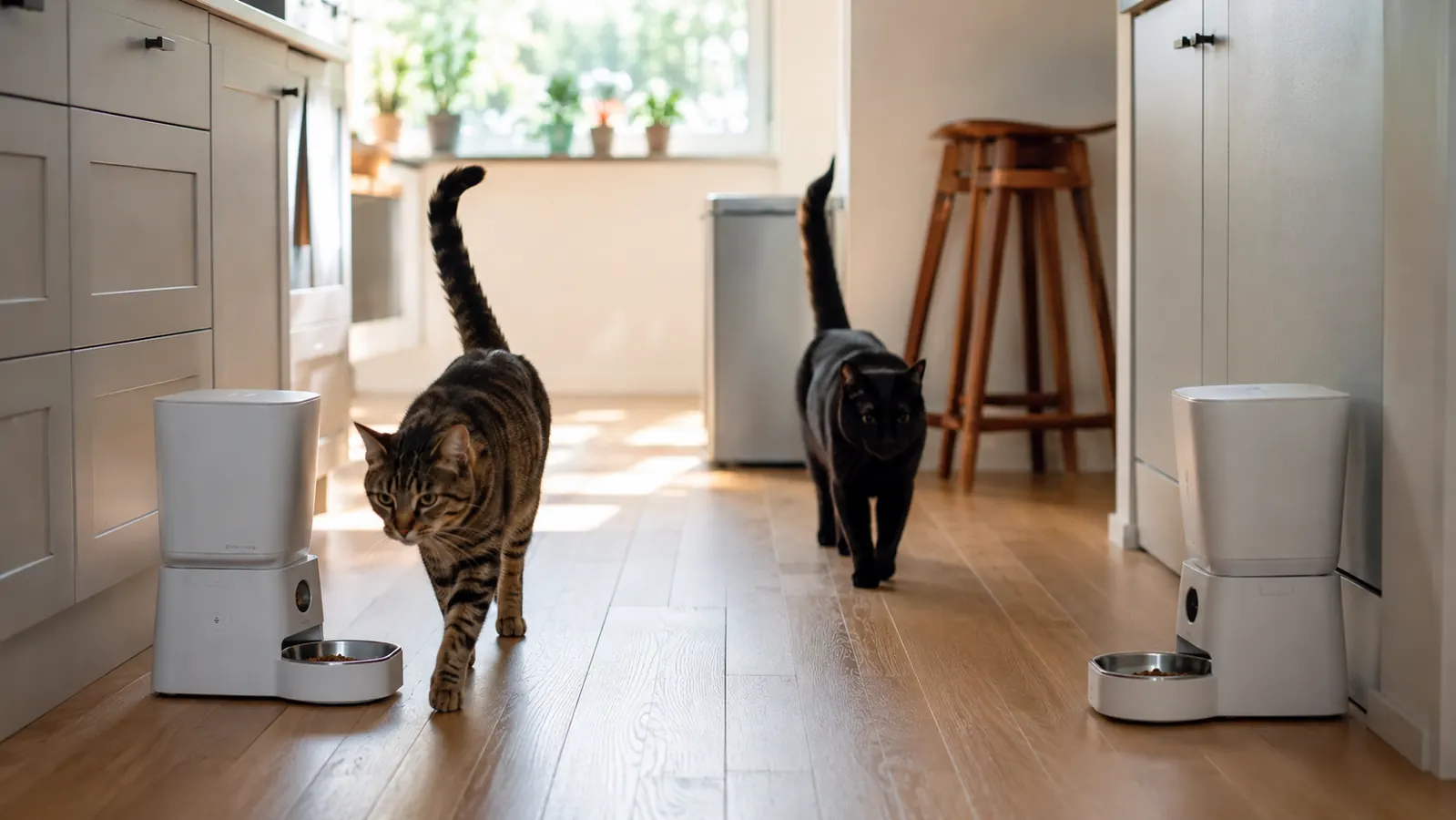
Here is the situation I kept running into: my tabby Miso needs exactly half a cup of dry food a day because of her weight, and my other cat Gouda would happily eat her portion, his portion, and whatever else he could find. A standard programmable feeder dispenses food on a timer and both cats could eat from it. Gouda always got there first, and Miso would find an empty bowl. After watching this play out for two weeks I went looking for a solution, and the PETLIBRO RFID Automatic Cat Feeder kept coming up in every multi-cat forum thread I found. The premise is simple: each cat wears a small RFID tag on their collar, and the feeder lid only opens for the cat it recognizes. Gouda's feeder stays closed when Miso walks up to it. Miso's feeder stays closed when Gouda approaches. The question worth asking before spending on the premium model is whether that feature is actually necessary for your household, or whether a basic budget feeder will cover what you need just as well.
If you have one cat with no special dietary needs, a single standard auto-feeder will handle the job without question. But if you have two or more cats with different portion requirements, or one cat who gulps food so fast she vomits, or a situation where free-feeding has caused one animal to pack on weight while the other stays thin, the RFID system addresses the specific failure mode that basic feeders cannot solve. This comparison walks through both options side by side so you can make the right call without buying the wrong thing first.
| Feature | PETLIBRO RFID Feeder | Standard Timed Feeder |
|---|---|---|
| Price range | Check today's price on Amazon | Mid-range per unit |
| Pet identification | RFID collar tag per cat; lid only opens for assigned pet | None; any pet can eat from it at any time |
| Portion control | Per-cat portion set independently in the app, up to 10 meals per day | Fixed amount dispensed on a shared schedule, typically 1 to 6 meals per day |
| Anti-gulp / slow-feed mode | Yes; programmable delay between portion drops to slow eating pace | Not available on most entry-level models |
| Food capacity | Approx. 25 cups (6-liter hopper) | Typically 6 to 12 cups depending on model |
| Power source | AC adapter with battery backup (4 D-cell batteries) | AC adapter or battery-only; varies by model |
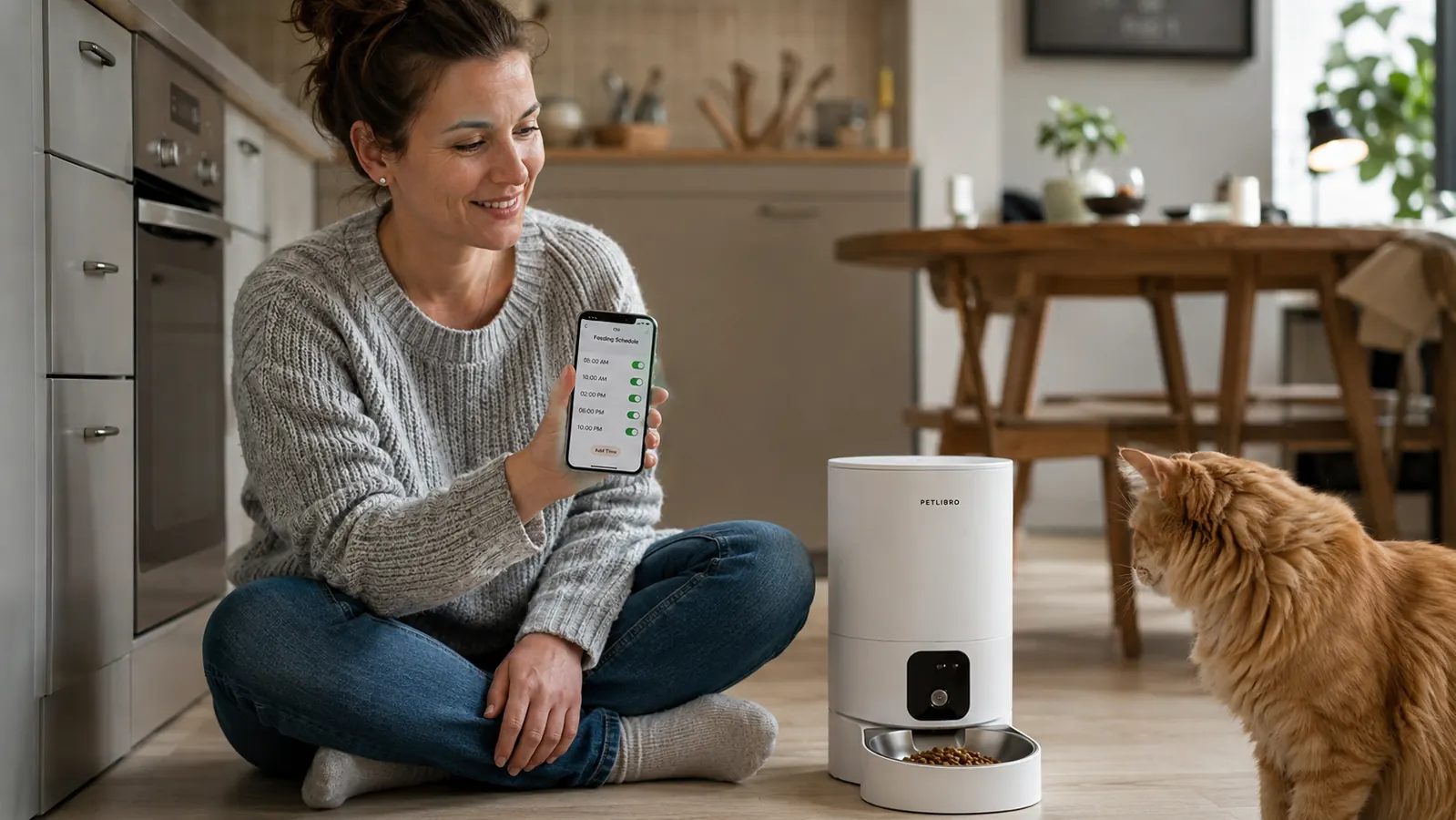
| App and WiFi control | Yes; iOS and Android app with feeding history and real-time alerts | Some mid-range models have an app; most budget units do not |
| Lid access control | Motorized lid locks while closed; requires RFID collar match to open | Open bowl or hinged flap; no access restriction |
| Setup complexity | Moderate; collar tag pairing and app configuration required | Low; set the clock and portion dial, press start |
Where the PETLIBRO RFID Feeder Wins
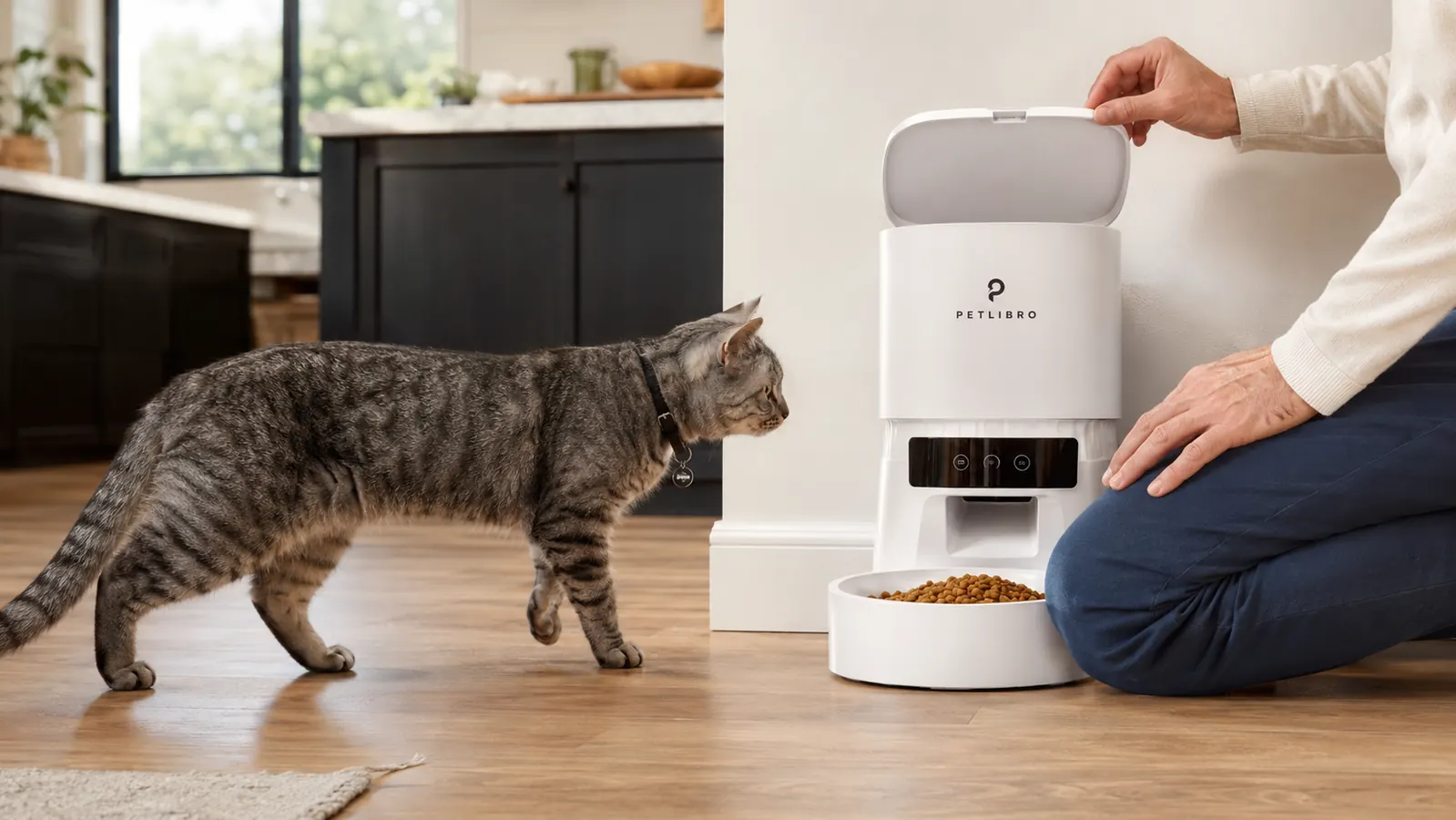
The collar-sensor design solves a problem that standard feeders simply cannot address by their fundamental design. If one cat is on a prescription diet, a weight-management plan, or needs smaller and more frequent meals because of a digestive condition, a shared open feeder creates a management problem every single day. You cannot control which cat eats what when the bowl is accessible to both animals simultaneously. With the PETLIBRO RFID, each unit is paired to one collar tag. When Miso walks up to her feeder, the lid opens. When Gouda tries the same feeder, nothing happens; the lid stays locked and he eventually walks away. For multi-cat households where weight disparity or medical dietary needs exist, that access control is the entire value proposition of this product, and it delivers on it consistently.
The anti-gulp feature deserves far more attention than the marketing materials give it. Gouda inhales his food in about 45 seconds and then vomits on the rug. It had been happening for most of his adult life and my vet told me repeatedly that slowing down the eating would help. The PETLIBRO lets you set a programmatic pause so the feeder dispenses a small amount, waits a set number of seconds, then dispenses the next portion. The total meal takes three to four minutes instead of under a minute. After two weeks on that schedule the post-meal vomiting stopped entirely. I had been cleaning up after him for over a year before I realized the eating speed was the issue, not the food brand. A standard feeder dispenses the full portion in one drop and fast eaters devour it in seconds. There is no mechanical workaround for that on a basic unit.
Battery backup is a feature I initially dismissed as a marketing add-on, but it proved its worth during a three-hour power outage. The PETLIBRO ran on four D-cell batteries and dispensed the next scheduled meal without any interruption. A basic feeder with no battery backup does nothing when the power goes out, which means your cat misses a meal. For cats on a strict feeding schedule because of health conditions, a diabetic cat whose food timing is tied to insulin dosing, or simply a cat who will howl at 4am if her schedule is disrupted, that backup matters. The unit also retains its programmed schedule in memory when the batteries take over, so there is no reprogramming required after the outage clears.
Where a Standard Timed Feeder Wins
Price is the obvious and meaningful advantage. A solid basic feeder runs in the mid-range and handles most single-cat homes without complaint. For a household with one cat of healthy weight who eats at a normal pace and has no special dietary requirements, spending premium money on RFID access control, a motorized lid, and app connectivity is genuinely unnecessary. The standard feeder sets a schedule, dispenses a measured amount of kibble, and does it reliably every single morning. That covers the core use case without any added complexity. You can put the savings toward better food or a vet visit.
Setup simplicity is also a real practical advantage. You set the clock, choose the portion size, and press start. There is no app to download, no WiFi network to connect, no collar tags to pair, and no troubleshooting to do when a software update breaks something at an inconvenient hour. Some pet owners, especially those who are not comfortable with app-connected devices, will find that simplicity genuinely preferable to the RFID system's configuration demands. Standard feeders also tend to have fewer moving parts overall, which means fewer things that can jam or wear out over years of daily use. The PETLIBRO has a motorized lid mechanism that cycles every single meal, and while mine has not had a mechanical failure in four months of daily use, the complexity is meaningfully higher than a simple rotating drum dispenser.
There is also the collar requirement to consider honestly. The RFID system only works if your cats wear collars with the RFID tags attached at all times. Some cats refuse to tolerate a collar. Some owners keep their indoor cats collar-free by preference or because their veterinarian has recommended it for safety reasons. And some collar-wearing cats are skilled at removing them, which means the feeder stops recognizing them until you track down the missing collar and reattach the tag. If any of those situations apply in your home, the RFID system introduces a recurring friction point that a standard feeder never creates.
Two cats. Two diets. One feeder that tells them apart.
The PETLIBRO RFID Feeder is the only mainstream option that uses collar sensors to control which cat eats from which bowl. If your cats compete for food or need different daily portions, this is the fix that actually works. Check current pricing and availability on Amazon.
Amazon Check Today's Price on Amazon →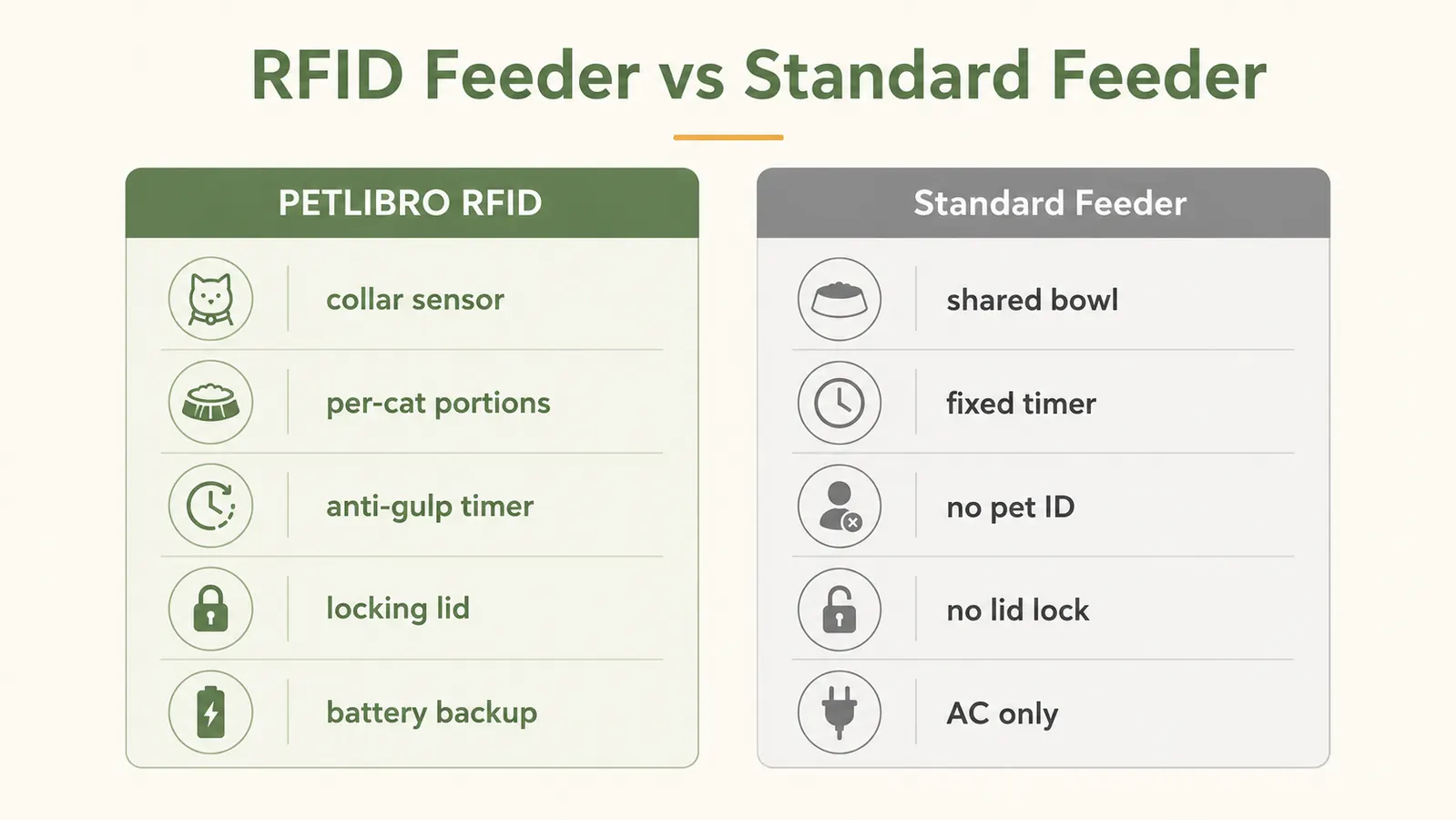
The Real-World RFID Experience: What the Spec Sheet Skips
The collar tags are small and light enough that neither of my cats noticed them after the first day or two of wearing them. Miso is a small shorthair at 8.5 pounds and the tag did not change her collar's weight in any noticeable way. Gouda at 13 pounds had the same reaction. The pairing process through the PETLIBRO app took about ten minutes per unit and worked on the first attempt without any issues. The app shows feeding history, which turned out to be more useful than I expected. I can see at a glance whether Miso skipped a scheduled meal, which sometimes signals she is coming down with something before I have noticed any other symptoms. That kind of passive visibility into your cat's eating habits is simply not something any standard feeder can offer.
After two weeks on the anti-gulp delay schedule, the post-meal vomiting stopped completely. I had been cleaning up after Gouda for over a year before I figured out that eating speed was the real problem, not the food itself.
There are real limitations worth naming before you buy. The motorized lid makes a brief whirring noise each time it opens and closes. It is quiet relative to most kitchen appliances, but in a silent bedroom at 5am it is audible enough to wake a light sleeper who is not used to it. The unit is also physically larger than a basic feeder, which matters if counter or floor space is tight. The hopper holds about 25 cups of dry food, which is generous for most cats but means you are storing a meaningful amount of kibble inside the machine. And the system is dry-food only. If your cats eat primarily wet food, or a mix of wet and dry, this feeder is not designed for that use case and you will need a different solution for the wet-food portion of their diet.
Who Should Buy Which
Buy the PETLIBRO RFID Feeder if you have two or more cats with different portion requirements, if one cat is on a prescription or weight-management diet, if you have a speed eater who vomits regularly after meals, or if app-based feeding history and real-time alerts would give you useful peace of mind. The RFID system earns its higher price by solving specific daily problems that basic feeders fundamentally cannot address. Budget for one unit per cat: a two-cat household needs two feeders, which is a real cost that changes the math on whether this is right for you.
Buy a standard timed feeder if you have one cat, that cat is at a healthy weight, eats at a reasonable pace, and has no special dietary requirements from your veterinarian. A programmable feeder in the budget range will do exactly what you need without app connectivity, collar tags, or mechanical complexity. It is a reliable, low-maintenance piece of gear that covers the foundational use case and nothing more. If your situation changes later, because you adopt a second cat or your vet puts your existing cat on a restricted food plan, upgrading to an RFID system at that point makes more sense than buying one now for a problem you do not actually have.
If you want a full breakdown of how the PETLIBRO RFID performs specifically after sustained daily use in a two-cat home, I covered that experience in depth in the PETLIBRO RFID long-term review. And if you want to understand the collar-sensor edge cases and setup friction that most reviewers skip over entirely, the honest review covers those in detail.
Ready to stop the mealtime food competition in your multi-cat home?
The PETLIBRO RFID Automatic Cat Feeder earns its price when you have a clear reason for it: two cats on different diets, a speed eater who needs portion help, or a household where food competition is already causing weight problems. If those conditions are true for you, check the current price on Amazon before you decide.
Amazon Check Today's Price on Amazon →